The pursuit of knowledge is as diverse as the learners undertaking its challenge. Recognizing the different learning styles that individuals embody can vastly enhance the study effectiveness of each learner. There exist 8 types of learning methods for effective study that cater to unique cognitive preferences, each serving as an optimal study technique to those who engage with them. From visual aids to sensory experiences, these methods provide a rich tapestry of educational approaches, allowing learners to engage with study material in the way that resonates best with them.
Understanding and applying one’s inherent learning style is not just about academic success; it’s a step towards personal growth and self-awareness. The flexibility to adapt to or integrate multiple learning styles can further amplify a learner’s potential, leading to more effective study outcomes. A learner who masters the skill of matching their learning approach with the subject at hand will likely enjoy higher levels of retention and comprehension, ultimately achieving academic excellence.
Key Takeaways
- Identifying individual learning styles can significantly improve study strategies and outcomes.
- Visual, auditory, kinesthetic, and reading/writing preferences are among the foundational learning styles.
- Multiplicity in learning methods allows for educational tactics to be tailored to learner needs.
- A mix of various learning styles can be beneficial, though one may predominate.
- Recognizing and utilizing one’s predominant learning method fosters an optimal learning experience.
- Flexibility and adaptability in learning strategies can lead to enhanced academic performance.
Understanding Your Learning Style for Optimal Study
Embarking on the journey to discover your unique learning style is the first step towards achieving optimal learning outcomes. Each individual processes information differently, influenced by several factors that constitute the mechanics of learning. To unlock the power of personalized education, a deep dive into these multifaceted components is essential.
Discovering How You Process Information
Identifying your learning preferences is synonymous with exploring the pathways through which you best absorb and retain information. Whether through visual stimuli, auditory input, or hands-on experience, understanding how you process information underscores the creation of an effective study strategy tailored to your needs.
The Influence of Cognitive and Emotional Factors
Cognitive factors such as memory, attention span, and processing speed are critical engines of your learning vehicle, dictating the tempo and efficiency of your educational journey. The emotional impact of learning is equally pivotal, with motivation and confidence steering the direction of your academic pursuits. Together, these elements propel learners towards their preferred, personalized learning style, contributing to the formation of an optimal learning environment that nurtures knowledge acquisition.
- Memory Capacity: Integral for retention and recall of information.
- Attention Span: Determines the duration of effective concentration.
- Processing Speed: Affects the rate at which new information is understood and assimilated.
- Motivation: Drives engagement and consistency in learning activities.
- Confidence: Encourages persistence in the face of challenging material.
By mindfully considering these factors, learners can harness their individualized learning style, enabling a tailored approach that maximizes study efficacy and educational satisfaction.
Visual Learning: Seeing Is Understanding
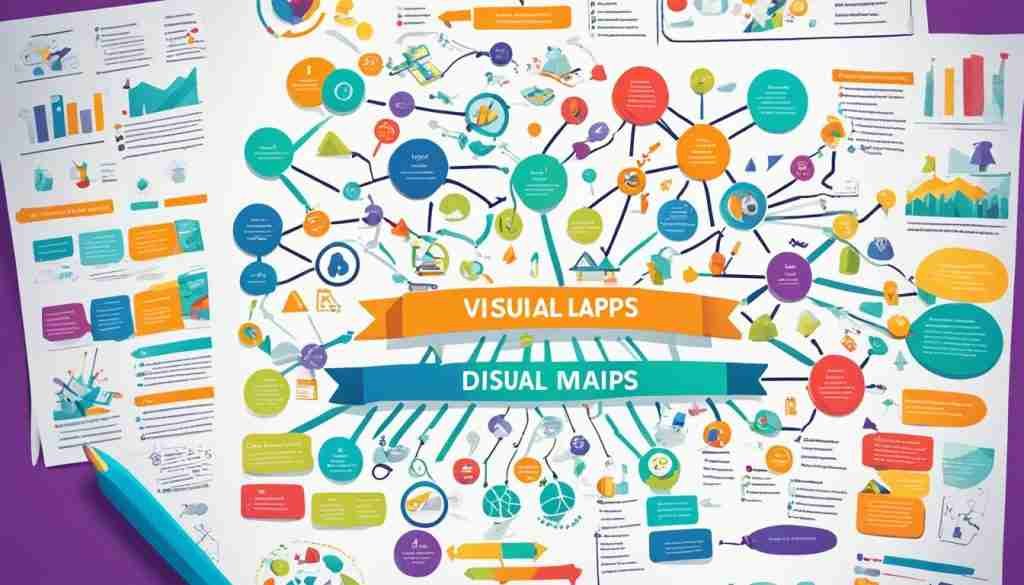
For those who identify as a visual learner, visual aids such as charts, graphs, and diagrams are not just helpful; they’re essential. These tools serve as the foundation of visual learning methods, enabling learners to capture and retain information more efficiently. They play an indispensable role in illustrating complex relationships in data, mapping out concepts, and simplifying the absorption of detailed subject matter.
Utilizing Charts, Graphs, and Diagrams
Charts, graphs, and diagrams are the bedrock for those who thrive on visual learning. These visual aids can transform abstract concepts into tangible visuals, facilitating a greater understanding of the material. Visual learners can enhance their comprehension by employing a variety of these tools, each suited for different types of information:
- Charts visually represent data, making trends and patterns quickly perceivable.
- Graphs articulate the relationship between variables, clearly showing how one aspect affects another.
- Diagrams visually explain the parts of a whole, aiding in the breakdown of complex systems for closer inspection.
These types of visual aids are cross-disciplinary and can be applied to almost any field of study, from the sciences to the humanities, proving the versatility and far-reaching benefits of visual learning.
Improving Retention with Visual Aids
One of the pivotal advantages of visual aids is the role they play in helping learners to retain information. By presenting knowledge in a visual context, it becomes more memorable. The use of color, shape, and spatial orientation in these aids can trigger associative memory, thereby aiding recall. Below is a table showcasing different visual learning tools and their efficacy in aiding retention:
| Visual Tool | Use Case | Retention Benefit |
|---|---|---|
| Flow Charts | Understanding processes | Sequential recall of steps |
| Bar Graphs | Comparative analysis | Recognition of quantitative differences |
| Venn Diagrams | Clarifying relationships between groups | Visualizing intersections of concepts |
| Mind Maps | Brainstorming and concept development | Integration of ideas and concepts |
| Pie Charts | Displaying parts of a whole | Understanding distribution and proportions |
In summary, engaging with these visual learning tools enhances understanding and significantly increases the likelihood that visual learners will be able to recall the information when it matters most.
Auditory Learning: Listening Your Way to Knowledge
For auditory learners, listening is not merely a passive activity but a dynamic process of absorbing and understanding new information. These individuals excel when information is presented in an aural format, thriving on the nuances of tone, pitch, and rhythm that auditory learning encompasses.
Practical strategies for these learners go beyond simply hearing the content; they involve active participation by the learner through various aural activities that may include lectures, group discussions, and listening to recordings. This method of learning places a strong emphasis on dialogues and articulation as powerful tools for comprehension.
Here are some auditory strategies that can enhance the educational journey of individuals who are inclined toward aural learning:
- Participating in discussion groups to encourage verbal engagement and debate.
- Attending lectures where they can listen to experts discuss complex topics in-depth.
- Using mnemonic devices through rhymes and music which help with memorization and retention of information.
- Recording their own voice and listening back to reinforce concepts and terminology.
Aural learners particularly benefit from repetition and the opportunity to verbalize their thoughts. What they hear resonates deeply, thereby supporting the development of their knowledge base and assisting in the mastery of languages and abstract theories.
| Activity | Benefits for Auditory Learners |
|---|---|
| Lectures and Talks | Enables grasping complex information through a structured verbal presentation. |
| Group Discussions | Facilitates learning through argumentation, critical thinking, and exposure to diverse perspectives. |
| Audio Books and Podcasts | Provides a convenient way to absorb information during downtime or while multitasking. |
| Repetition and Mnemonics | Enhances memory retention via rhythmic repetition and auditory pattern recognition. |
“Listening is learning. For those attuned to the nuances of sound, spoken words are not just heard—they are understood.”
To sum up, auditory learning caters to an essential group of learners for whom listening is not simply a background activity but a primary vehicle for education. Harnessing the power of aural input paves the way for these individuals to absorb knowledge intuitively and effectively.
Kinesthetic Learning: Hands-On Approach for Tactile Learners
For those who exhibit the characteristics of kinesthetic learners, education extends beyond the visual or auditory; it requires a hands-on learning experience that fosters a deep connection with the subject matter. These individuals assimilate knowledge most effectively when they’re allowed to use their sense of touch and movement for a real tactile experience. Referred to as tactile learners, they process and retain information through physical involvement, making experiential learning fundamental to their educational advancement.
Whether it is through engaging in lab experiments, crafting models, or participating in role-play, these kinesthetic learners benefit from an education that embraces movement and action. This hands-on strategy is not just for younger students; it can be applied in higher education and professional development courses, infusing traditional curricula with dynamic educational experiences that target those who identify as a physical learner.
Kinesthetic learning isn’t just about doing; it’s about reflecting on the doing. This is where a learner transforms simple actions into profound insights, fostering an environment where tactile experiences translate into deep, memorable lessons.
The value of kinesthetic learning extends to numerous fields, from arts to engineering, and recognizes the importance of tactile experience in solidifying complex concepts. As we enter a more interactive future, the educational system continues to evolve, integrating technology with hands-on techniques to support kinesthetic learners in becoming active participants in their journey of education.
- Participating in workshops where knowledge is applied
- Conducting physical experiments to explore scientific theories
- Building prototypes to understand engineering principles
- Engaging in simulations to practice medical procedures
- Using manipulatives for mathematical problem-solving
Ultimately, kinesthetic learning strategies are vital in a customized educational approach that honors the diverse needs of learners. These immersive experiences cater to kinesthetic learners and enrich the learning environment for all, promoting an inclusive and comprehensive educational landscape.
Word-Based Learning: Reading and Writing to Comprehend
For individuals who identify as reading/writing learners, the path to understanding and retention is paved with words. Unlike other learners who might rely on visual or auditory representations, these verbal learners find comfort and efficiency in the nuances of text-based information. The dominance of word-based learning among certain students necessitates an educational focus on literacy, grammar, and vocabulary to enhance their text comprehension.
Teachers and educational programs play a pivotal role in nurturing the potential of reading/writing learners by presenting knowledge primarily in linguistic form. Exercises such as extensive reading, structured note-taking, and summarizing written content are essential to ensure that these learners can effectively retain information through writing.
The success of reading/writing learners often manifests during activities that require a strong command of the written word, such as essay writing or interpreting and constructing arguments within texts. The table below outlines essential practices that can significantly bolster a reading/writing learner’s journey to mastery:
| Practice | Description | Benefits |
|---|---|---|
| Note-Taking | Writing down key points and summaries during lectures or from reading materials. | Enhances understanding and review of complex concepts. |
| List Making | Creating bullet points or lists for categorization of information. | Promotes organization and prioritization of ideas. |
| Analyzing Text | Critical examination of texts to understand underlying themes and perspectives. | Develops analytical skills and deeper content engagement. |
| Essay Writing | Composing structured essays to formulate and express views clearly. | Refines communication skills and aids in articulating complex thought. |
| Text Illustration | Utilizing diagrams or symbolic representations to visualize textual information. | Provides alternative means to connect with the material on a verbal level. |
| Journaling | Keeping a personal log of thoughts, learning experiences, and reflections. | Encourages consistent writing practice and self-reflection. |
The growth of logical learning is shaped by the innovative ways analytical learners approach knowledge accumulation. Individuals categorized as logical learners have a natural affinity toward logical learning and apply analytical thinking to dissect complex concepts. A foundation of structured thinking supports their proficiency in developing problem-solving skills. This article section delves into strategic practices that nurture the distinctive cognitive abilities of analytical learners.
Strategies for Logical/Analytical Learners
Enhancing the educational journey of a logical learner involves integrating strategies that foster a deeper understanding of intricate problems. Methods such as puzzle-solving, strategic games, and algorithmic challenges effectively engage these learners. Additionally, high-impact practices involving problem-based learning tasks require the learner to navigate scenarios that mirror real-world challenges, thus honing their analytical capabilities.
Enhancing Learning with Structured Thinking
Scaffolding lessons with a clear progression from simple to complex tasks further fortifies the effects of structured thinking. By presenting material logically, learners can build on previous knowledge systematically, promoting cognitive coherence and competence in their subject of study.
| Technique | Description | Benefits |
|---|---|---|
| Syllogistic Reasoning | Utilizing logical deductions to form conclusions from two or more propositions that are stated to be true. | Improves critical thinking and the ability to build rigorous, valid arguments. |
| Causality Challenges | Exploring cause and effect within scenarios to understand the relationship between different elements and their impacts. | Enhances the capability to identify and analyze dependencies and consequences in systems. |
| Pattern Recognition Exercises | Identifying sequences and consistencies within data sets or physical models. | Strengthens recognition of underlying principles and predictability in complex structures. |
Fostering an inclusive educational atmosphere that celebrates this diversity can result in more engaged and successful learners. Below is a breakdown of these different learning styles and some tailored study practices that can be implemented to enhance the educational outcome.
| Learning Style | Description | Study Practices |
|---|---|---|
| Visual | Learners who prefer to use images, colors, and spatial understanding. | Use diagrams, mind maps, and color-coded notes to organize information. |
| Auditory | Learners who engage best by listening. | Implement discussion groups, lectures, and mnemonic devices for recall. |
| Kinesthetic | Those who learn through physical activity and hands-on experience. | Incorporate lab sessions, field trips, and interactive models. |
| Logical | Learners who excel with logic, reasoning, and systems. | Emphasize puzzles, problem-solving activities, and structured tasks. |
| Social | Individuals who prefer to learn in group settings. | Facilitate peer tutoring, group projects, and collaborative workshops. |
| Solitary | Those who work best alone and through self-study. | Create personal learning plans, private study spaces, and self-assessment tools. |
| Verbal | Learners who favor using words, both in speech and writing. | Employ reading assignments, writing tasks, and oral presentations. |
| Naturalistic | Learners who draw strength from interacting with the natural world. | Engage with field observations, environmental projects, and contextual learning. |
Understanding these diverse learning methods paves the way for tailored study practices that respect individual learning paths and promote effective knowledge transfer. Educators need to appraise and adopt diverse strategies to accommodate varying learner preferences, and equally, students should reflect on their preferred learning styles to fully capitalize on their educational opportunities. Thus, adaptation and personalization cultivate a more enriching learning environment, benefiting all involved.
Social Learning: Collaborative Methods to Engage and Retain
New pedagogical approaches recognize the profound impact of social learners in today’s educational landscape. Defined by their preference for collaborative learning and group study sessions, these individuals often demonstrate higher engagement levels and deeper knowledge retention when participating in a social learning environment. Key to this approach is the understanding that through collective problem-solving and interactive learning experiences, all group members can benefit from shared knowledge and insights—this is the essence of peer learning.
Proactive strategies are pivotal in maximizing the effectiveness of social learning. These may involve structured activities where learners collaborate on projects or participate in discussions. Such strategies are designed not only to facilitate the sharing of ideas but also to encourage a sense of community and mutual support, which enriches the educational experience.
Educators promote an interactive pedagogy that mirrors real-world interactions by incorporating role-playing and communication exercises into the curriculum. This enhances social learners’ learning experience and prepares them for the collaborative nature of the modern workplace.

To illustrate the distinct benefits of collaborative efforts, consider the following intellectual pursuits typically embraced by social learners:
- Joint problem-solving tasks where learners bring diverse perspectives and unique problem-solving approaches to the table.
- Debate teams that foster analytical thinking and articulating complex ideas through discourse.
- Peer review sessions cultivate a culture of constructive criticism and self-reflection.
- Learning communities centered around specific subjects which allow in-depth discussions and analysis.
Social learners often become natural facilitators and leaders within groups, guiding discussions, and fostering an atmosphere of equality and respect. This dynamic is conducive to an empowered learning community where all voices are valued and where the process of learning becomes as significant as the educational content itself.
Adapting teaching methods to accommodate and stimulate social learners is beneficial for all students and enhances the learning environment. By integrating collaborative learning opportunities, educators can encourage a more vibrant, diverse, and effective educational experience that speaks to a wide range of learning styles.
Solitary Learning: Independent Study Techniques
Solitary learning caters to the solitary learner, who thrives when mastering subjects through independent study techniques. This approach to learning emphasizes the importance of a quiet, personalized learning environment, free from external distractions, allowing an individual to maximize focus and effectively engage with the material on a profound, personal level.
Maximizing Focus with Individual Learning Strategies
To enhance the solitary learning experience, individual study strategies are developed to align with the learner’s unique learning pace and specific cognitive preferences. Setting clear goals, utilizing time management skills, and employing strategic breaks can lead to a more productive solitary study session.
A key component of solitary learning is the ability to dive deeply into personal interests and inquiries, fostering an environment where self-motivation and self-discipline drive one’s educational journey. When solitary learners craft their study rituals and routines, they pave the way for uninterrupted, concentrated learning experiences.
Personalizing Your Study Environment
Creating a personalized learning environment is paramount for solitary learners. Students can better focus on their study strategies by tailoring their surroundings to minimize distractions and maximize comfort. Customized study spaces might include ergonomic furniture, optimal lighting, and resource accessibility that stimulate focused learning.
Understanding one’s learning preferences can also significantly influence environmental personalization. Whether it requires complete silence or the soft hum of white noise, solitary learners can manipulate their study settings to suit their particular needs, ultimately enhancing their ability to absorb and retain information.
| Personalized Learning Factor | Benefit to Solitary Learners |
|---|---|
| Controlled Noise Levels | Better concentration and reduced auditory distractions |
| Customized Study Schedule | Alignment with natural energy cycles for improved efficiency |
| Organizational Tools | Enhanced ability to track progress and manage tasks |
| Choice of Study Materials | Engagement with preferred learning resources for deeper understanding |
| Ergonomic Setup | Reduced physical strain allows longer, more comfortable study periods |
Experiential Learning: Real-World Application for Concrete Experience
Experiential learning is a transformative educational approach that champions real-world application to facilitate concrete experiences. By engaging in experiential learning, students partake in hands-on activities, ranging from internships to simulations, that echo the complexities of real-world scenarios. This method underscores the value of tactile experience and physical interaction as learners dive into environments that mirror professional settings or genuine tasks.
The cornerstone of experiential learning is that students learn more effectively when directly involved in the learning process. Instead of passively absorbing information, learners become active participants, which fosters a deeper understanding of the subject matter. Every success and setback becomes a learning opportunity in these immersive settings, contributing to a well-rounded educational journey.
- Collaborative projects with peers simulate workplace teamwork dynamics.
- Fieldwork offers insights into practical challenges and industry standards.
- Role-playing exercises embody theories in action, promoting critical thinking and adaptability.
Integrating experiential learning in curricula helps bridge the gap between theory and practice. Its emphasis on application prepares students for their future careers and enlivens their educational experience with relevance and engagement.
Adaptative Learning: Customized Education with Modern Technology
The educational landscape is undergoing a significant transformation by integrating adaptive learning techniques. By customizing education with modern technology, such as EdTech platforms and artificial intelligence in learning, educational institutions can offer a highly personalized learning experience.
Leveraging EdTech for Personalized Study Programs
Using sophisticated algorithms and data analysis, EdTech solutions can identify individual learner’s strengths, weaknesses, and learning styles. By assembling this data, programs are tailored to suit personal learning pathways optimized for the most effective absorption of knowledge and skills. Moreover, this technology reduces the one-size-fits-all approach to education, making room for personalized tutoring and support.
The Role of Artificial Intelligence in Learning
Artificial intelligence is the backbone of adaptive learning, providing real-time insights and recommendations to educators and learners. AI-driven platforms can adjust the difficulty level of tasks, introduce new topics appropriately, and suggest alternative learning strategies to enhance understanding. The role of AI cannot be overstated, as it provides a dynamic and responsive educational experience that is unprecedented in traditional learning environments.
Adaptive learning systems empower students to take control of their educational journey, making learning more engaging and effective. As these technologies evolve, we are likely to see even more innovative applications of AI in education, further revolutionizing the way knowledge is imparted and acquired.
Conclusion
The journey toward effective learning intertwines with a profound understanding of the learning process. By delving into various study habits and recognizing individual preferences, learners can sculpt their education for the best learning experience. The meticulous employment of learning methods—ranging from the visual to the kinesthetic and the logical to the social—plays a critical role in the retention of study material. These tailored techniques promote better memorization and foster an environment where information crystallizes into knowledge with greater ease.
Undeniably, the advent of adaptive technologies has irrevocably altered the education landscape. These modern tools have revamped the learning process, allowing for a degree of personalization once thought unattainable. By harnessing the potential of such developments, the limitations of traditional learning are surpassed, enriching the educational tapestry for individuals across the spectrum of study habits and learning styles.
The amalgamation of tried-and-true methodologies with pioneering innovations offers us a potent formula for academic success. In doing so, we empower our learners to absorb information and achieve mastery and excellence. As we continue to enhance these learning processes and memorization techniques, we lay the foundations for a future where each scholar can attain their pinnacle of educational prowess. Ultimately, it is through the lens of these diverse and dynamic learning styles that we can foresee a bright horizon for learners worldwide.
Frequently Asked Questions (FAQ)
What are learning styles?
Learning styles refer to how individuals prefer to learn and process information. Understanding your learning style can help you study more effectively.
How do learning styles impact learners?
Learners may have different learning preferences, such as visual, auditory, or kinesthetic. Recognizing these preferences can help individuals retain information better.
What are the types of learning styles?
Learning styles include aural learning, hands-on learning, verbal learning, and more. Each individual may have a preferred learning style that suits them best.
How can different learning techniques enhance the learning process?
Different learning techniques and study methods can improve the learning experience and help individuals better comprehend and retain information.
Is it beneficial to study in a group or individually?
Both group study and individual learning have their advantages. Some people may thrive in a study group, while others may prefer to study as a solitary learner.
How can a variety of learning materials aid in the learning process?
Learning resources such as flashcards, mind maps, and study materials can enhance learning strategies and cater to different learning preferences.